What We Can Learn from the Repertoire at TROMP 2026
Looking through the repertoire from the 2026 TROMP Next Gen Mallet Competition, I kept coming back to the variety of ways a player can put together a program. Andrew Thomas’s Merlin appears alongside works by Scarlatti, Ligeti, Zeltsman, and music with tape. Some players built their programs around original percussion repertoire. Others looked to the piano, harp, or string instruments. For students choosing their next piece, there is a lot here to explore. For educators, there is also a useful opportunity to talk about how those pieces can fit together and help expand our repertoire as performers.
So to start off, I've been a little bit nerdy and technical and organized all the repertoire into a repertoire spreadsheet below. I’ve left out the competitors’ own compositions, with the exceptions of works by Joey Eng and Michael Crane, who have their works published. All the arrangements that the competitors or others made remain on this list. The available programs gave us 73 distinct works from a field of 50 competitors, across the semi-final and final. The semi-final programs for Moritz Wiedenmann and Florentin Klingelschmitt are missing and I was not able to track down their programs, so if you were at the competition and have them please feel free to send them my way. This data is all from the TMSQR app and double checked with competitors at the competition, as I was not in attendance for the competition.
As to be expected at an international competition Merlin by Andrew Thomas was the most frequently performed work, appearing in five programs across the semi-final and final round. Bowen Dong and Zheng Cui performed both movements, while Yoshitaka Kojima and finalist Cathy Su performed only the second movement. Leonardo Antòn Bertolino also programmed Merlin, although the movements are not specified on their program. The next most frequently performed works were Niflheim, Loops IV, and Pius Cheung’s arrangement of Verano Porteño, each appearing three times. I was happy to see that Verano Porteño, an arrangement for marimba, is seeing so much love on the international stage. There were also some lesser played selections such as Ripple, Birdscape, Marimbology’s Sarabande, and Black Velvet by Nancy Zeltsman. I was pleasantly surprised and enjoyed seeing such a wide variety of repertoire in these competition programs.
So along with this mainly being a marimba focused competition, as we can see from the repertoire selected, the vibraphone does still deserve attention here. The vibraphone selections included Donatoni’s Omar II, López López’s Cálculo secreto, Matalon’s Short Stories, Juri Seo’s v, and Manoury’s solo from Le Livre des Claviers. I was very happy to see that some contestants programmed vibraphone. I know that it can be daunting sometimes to step outside of what we know best, especially if we spend more time playing marimba than vibraphone. Programming vibraphone gives us an opportunity to balance our repertoire choices and show a different side of our musicality.
Beyond the standard repertoire, I was especially excited by the range of arrangements and adaptations in these programs. Competition winner Florentin Klingelschmitt’s final Round combined Bach’s Partita No. 2, Godefroid’s Étude de concert, and Franck’s Prélude, Choral et Fugue, all adaptations. Elsa Roth’s final round brought together Jacquet de la Guerre, Ligeti, Bach, and Schumann. Both of these programs show that the performers were not afraid to program works outside of even the adaptation canon for the instrument, and in many cases were heavily rewarded for their risk.
So what are some of the benefits for playing an adaptation at a competition? When you work on an adaptation, you need to listen closely to performances on the original instrument: how the players shape a phrase, sustain a line, and work with the instrument’s natural decay. You must also decide which voice needs to remain clear and where the harmony needs room to change when we don’t have the same capabilities as say a piano with 10 fingers. Working out how to play the piece on mallet instruments can deepen our understanding of its voicing, harmony, and our phrasing decisions. For many of these older works, we also have centuries of performance practice and a wide range of recordings to draw on.
As many of you who might be reading this might already know, I am a big fan of adaptations, and most of my repertoire consists of piano and string works. I think that this competition really has helped push adaptations more into center stage for marimbists and hopefully we see other competitions and student recitals start to follow suit, and program more adventurous adaptations beyond Bach.
So why does this matter and why am I sitting here writing about my opinion on what people played at a competition in the Netherlands? If you are a student or professional putting together a recital, spend some time with this list of pieces I have compiled and see if there's anything you have never heard before. Maybe you could find a hidden gem here instead of playing the familiar pieces we hear so often. For me I had never heard the Berkeley that Yifan programed, and I really enjoyed diving into some of their other music afterwards. If you are preparing an undergraduate or graduate audition, this list can also help you explore repertoire choices that are lesser played. Instead of playing Khan, Merlin, or Velocities for the hundredth time, we can consider a lesser played work, such as Ripple, Postlude no.1, or Echeveria.
I hope you found some of the ramblings of my brain informative or useful in some way for you. Now for the thing everyone came here for… the competition data.
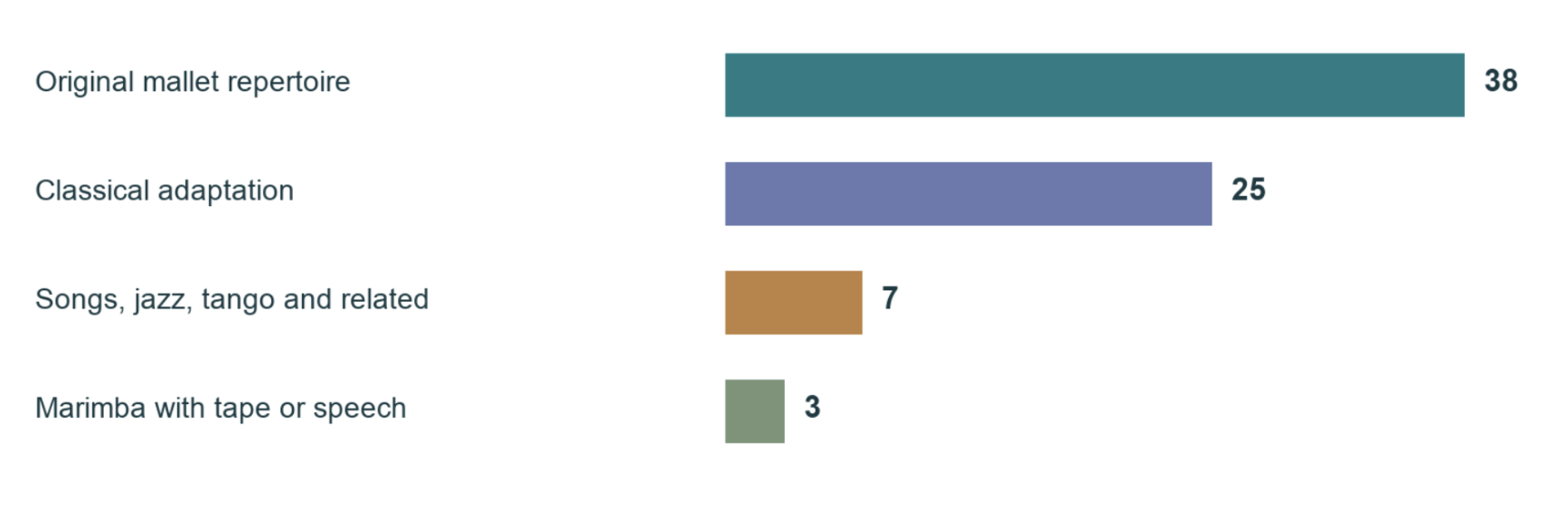
Figure 1. A broad mix of repertoire: 73 distinct works, grouped by category.
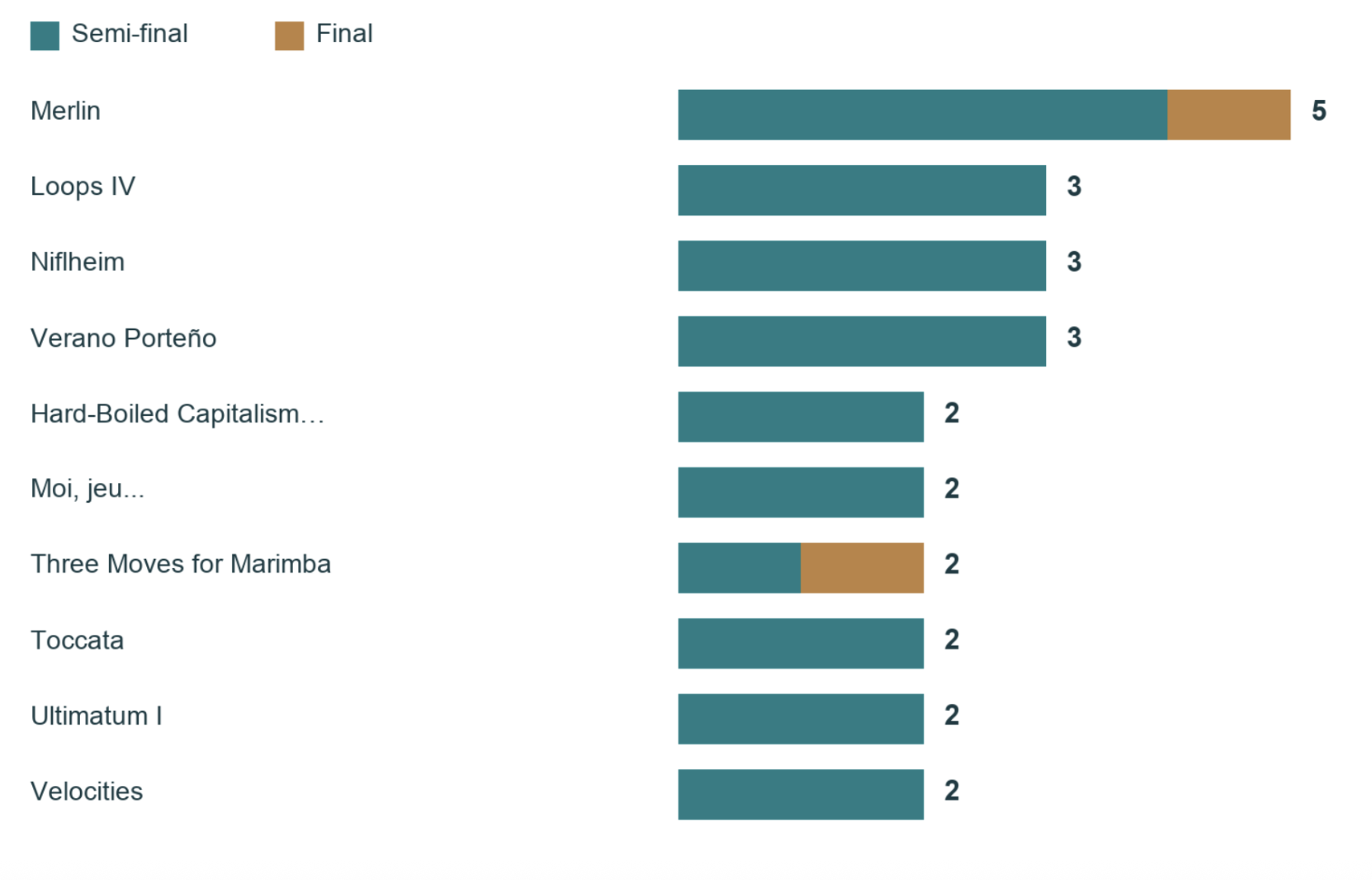
Figure 2. Works appearing more than once: program appearances across the semi-final and final, with selections from the same work grouped together.
Full Repertoire List
[SF] = semi-final; [F] = final | Missing programs for Moritz Wiedenmann and Florentin Klingelschmitt [SF].